Mingalaba! I am sorry to leave Myanmar and the wonderful people I met on the Road to Mandalay. Vow I will come back some day. I arrive in Bangkok and 6PM and am able to get a taxi, only to learn the red shirt protest had increased in numbers as well as ferocity. Traffic is jammed up for miles and my taxi driver is as frustrated as I am. Finally, we reach my hotel and the staff greets me like a lost relative returning home.
Wednesday, March 31, 2010

Tuesday, March 30, 2010
Last day on the Road to Mandalay


Mingalaba! Today is the last day on the boat and we are doing a cyclo ride through Myin Yu. We get to shore and the cyclos are lined up for our group. Another chance for locals to giggle at the procession of white people being paraded through their town. We stop at a place where local women cut their beautiful hair to sell to China, then to a place that makes replica costumes of the past royalty to be used for celebrations and on to a local market.
The market is not geared to foreigners, but we all make some great purchases. One of my friends on the boat wanted a monk’s robe and he found it there. I bought a monk’s fan and 2 little parasols that are put over little Buddha statues in one’s home. Mr Thet explained through out this trip that the two biggest temptations to a monk are money and women. The monk uses the fan to cover his face when women are around so he is not tempted.
Return to the boat to pack for a 5:30AM departure to Mandaly for our flight to Yangon.
Monday, March 29, 2010
Trip to Monwya Tour


Mingalaba!! Today we are in for a very long day and it is hotter than Hades. The ship has dropped anchor at Myin Mu, where we get off the boat and into the bus. Our first stop is a peanut factory, then lunch, where they fanned us while we ate.
We are on the way to a copper mine, which is a joint venture between the junta government of Myanmar and a company from Canada. As we are driving, we cross a bridge that was paid for by the women of this community, by way of selling their hair to China.
We visit the Peace Pagoda, with 5000 Buddha figures.
The locals do a primitive variety of mining seperate from the large mine. They use tin cans, acid and water from ponds of fetid water. One man sucked on a hose, and when the acid began to come, he then put it over the cans. He then spit, but what a way to make a living. I would think the acid would eventually destroy the tissue in his mouth. One need not worry about teeth in this part of the country, because most people chew and are addicted to the betel nut. When they chew this, the spit looks as if they are spitting blood. It destroys the gums and the teeth fall out. We give the kids in this village the peanuts we had bought earlier in the day, hoping they eat those instead of the betel nut.
We don't get back to the boat until dark and are all exhausted.
Sunday, March 28, 2010
Nyaung Oo Market

Mingalaba! We are going shopping this morning, but before we go the ship is going to provide morning meal for the monks. There are over 5,000 monks in Bagan and they are not allowed to cook for themselves, so each morning they must go to the villagers and ask for rice from the cook pot in each house. It is considered an honor to feed the monks who give up all worldly possessions to follow their religion. The kitchen staff has a huge table set up on shore and the monks of all ages file through the line.
We go first to a lacquer work shop and see the procedure of this fine precise art and then to Nyaung-Oo market. We arrive at the market and Mr Thet says we have 40 minutes before we must return to the bus and then the ship. I feel like I am reliving that TV show where people were in a grocery store and had only a few minutes to throw everything into their shopping cart before the bell rang. Bartering is out of the question, I don’t have time. Ready set go! A lacquer tube for paintings, a mother of pearl soap dish, lacquer bracelet, 2 mandarin blouses with matching lonjyis, two silk scarves, two pillowcases, and a puppet.
The puppet vendor is where I find my two friends from San Francisco bartering with the guy for two very large puppets. My watch says it is pumpkin time and as we all run for the bus I see stalls for a million things I would like to pick up, but time is not on my side. We all scramble back on the boat and set sail for Mandalay.
Saturday, March 27, 2010
Mount Popa


Mingalaba! Today, we take a bus to Mout Popa, a national park and believed to be the sacred home of powerful “Nats.”(spirit gods) Superstition is rampant in Myanmar, as is the spirit world and astrology readings. We stop at Mount Popa Resort for lunch and the view is spectacular of Mount Popa set a top of a rocky crag with a complex of temples and pagodas for the Nats. The rocky pinnacle is so high the clouds float below it giving it a Shangri-la image.
After lunch we go down to the town at the base of the Mount. There are 777 steps that wind precariously up the side of the mountain to reach the Nat home. In the town below there are monkeys every where and a museum that houses the replicas of the Nat spirits.
On the way back to the boat, we stop at a palm plantation, where they climb up the tree to seek palm oil that is made into candy and a strong alcohol.
Friday, March 26, 2010
Bagan


Mingalaba! This morning the ship arrives in Bagan where 2,000 pagodas and stupas are spread out across a plain beside the river.
We depart the boat and get on Bagan horse carts to visit Ananda Temple, Sulamani Temple and Shwezigon Pagoda. The horse carts allow the driver and one passenger in the front and another person in the back. One of my fellow travelers is allergic to horses and the other to dust, so when we arrive at the holy sites there is much sneezing with runny eyes and noses.
We attract people selling rubies and sapphires for $10, sanskrit pictures, and cherots.
We return to the boat for lunch. In the afternoon, we visit the lacquer centers for which Bagan is famous.
Thursday, March 25, 2010
Sailing on the Irawaddy River
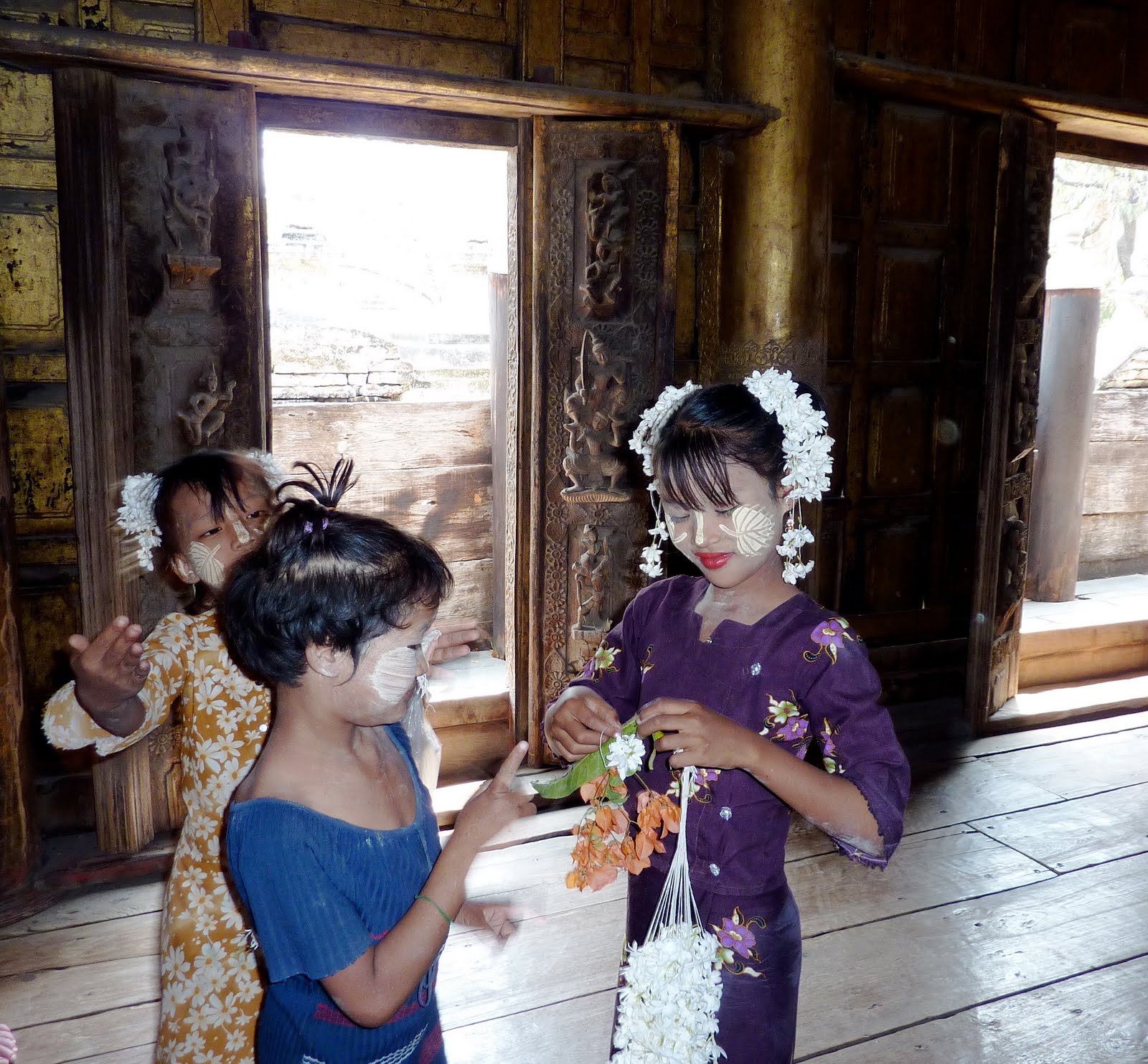


Mingalaba! Walking tour of a Shanlay village in the morning and when we return the ship sets sail and we spend the rest of the day observing the local river life from the top deck. On the shore are ox carts with wooden wheels; the boats on the river are dugout canoes. The people wash their clothes on the rocks and life looks hard to me, but the people are lovely with they’re wonderful smiles and joy of life as it is.
The Road to Mandalay always had experts giving lectures on the history of this lovely country, puppet shows, musicians and plays of Myanmar. On this afternoon, a youg woman demonstrated how to apply thanaka to our faces. Thanaka, a gray paste made from tree bark is a fabulous sun screen and a natural face mask. All women and children we saw had this on their faces. She also gave a demonstration on how to wear and tie a lonjyi, which is worn by men, women and children.
Subscribe to:
Posts (Atom)